The useful unit of optimisation in airport operations is not the individual resource. It is the turnaround and its downstream network consequences.
An aircraft on the ground creates a tightly coupled sequence of work: stand availability, passengers, baggage, cargo, cleaning, fuelling, catering, ground power, pushback, crew, engineering and air-traffic constraints. Each function may have its own system and local KPI. The departure is the result of all of them.
Local optimisation creates global problems
A gate allocation that looks optimal for terminal utilisation can create a towing problem. A ground-support equipment schedule that minimises travel distance can leave insufficient resilience for a disrupted stand. A staffing decision that is efficient under the original schedule can fail after a late inbound compresses two turnarounds into the same window.
AI should therefore be designed around the constraint network rather than one application.
A-CDM provides the right operating idea
Airport Collaborative Decision Making is valuable because it treats the turnaround as a sequence of shared milestones and improves predictability across airport operators, airlines, ground handlers and air-navigation stakeholders. EUROCONTROL's current A-CDM specification emphasises significant events that update downstream estimates and notifications.
That is exactly the type of environment where AI can add value: continuous re-estimation as conditions change.
Build a live turnaround state model
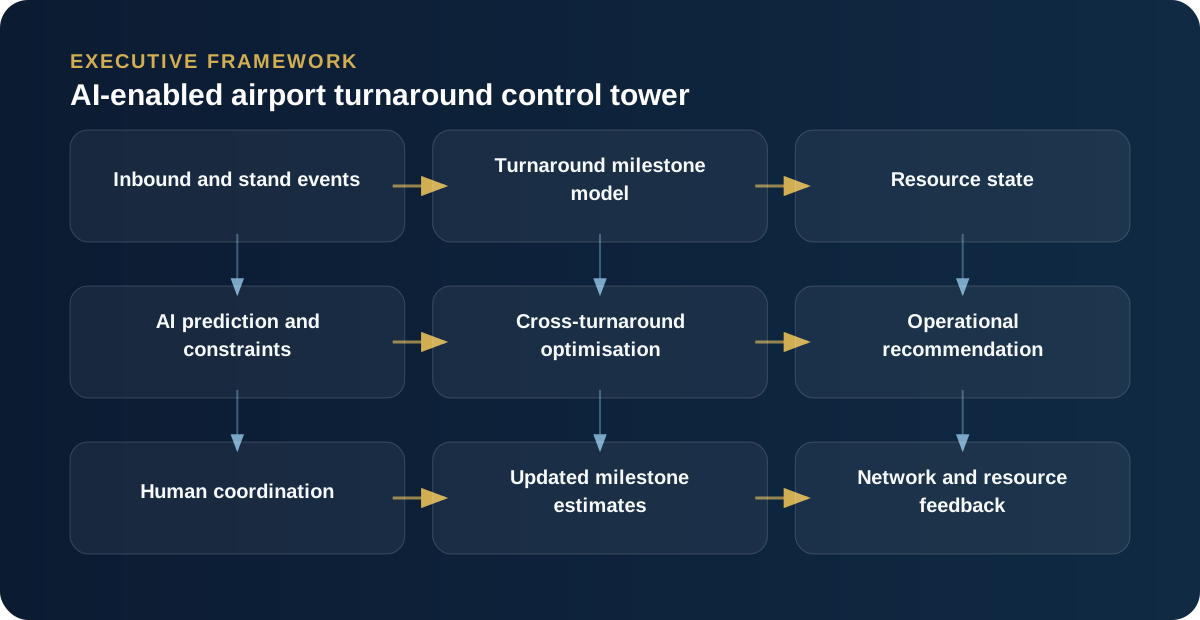
The AI layer needs a structured picture of each turnaround: scheduled and estimated times, completed milestones, outstanding activities, resource assignments, constraints, dependencies and confidence. This is more useful than asking a model to infer operational state from unstructured messages.
IATA's ground-operations work also points toward structured turnaround timestamps and AI-enabled observation of stand activities. Computer vision, telematics and operational systems can create increasingly precise event signals.
Use AI for prediction and orchestration, not opaque command
High-value patterns include predicting milestone slippage, identifying the constraint most likely to drive departure delay, recommending resource reassignment, summarising the impact of a change and alerting the right operational owner.
The AI can propose a coordinated response: move a belt loader, bring forward a cleaning crew, change a stand service sequence, or flag that no local resource move can recover the departure because the limiting constraint is external.
The important design feature is explanation. Operations staff need to know which milestone is driving the recommendation and what trade-off the proposed move creates elsewhere.
Optimise resilience, not only utilisation
Airport operations cannot run every resource at theoretical maximum utilisation. Some spare capacity is resilience. A model that aggressively removes slack may improve average efficiency and make disruption recovery worse.
The objective function should therefore include service reliability, coverage and recovery capability as well as resource cost.
What an AI-enabled turnaround control tower needs
- A shared milestone model and common time semantics.
- Live resource status and capability.
- Flight, stand and operational constraints.
- Travel and access information.
- Prediction confidence and explanation.
- Cross-turnaround conflict detection.
- Human operational authority and override.
Measure predictability as well as speed
A useful AI system may not always make the theoretical fastest turnaround. It should improve the accuracy of operational estimates, reduce avoidable delay, make resource conflicts visible earlier and help teams recover more consistently when the plan changes.
That is a more valuable objective than producing another dashboard that tells operations what happened after the aircraft has already departed late.
Optimise the turnaround as a system of constraints
An aircraft turnaround is a chain of interdependent activities: stand availability, passenger flows, baggage, catering, fuelling, cleaning, ground power, loading, crew and pushback. Optimising one resource locally can simply move the delay elsewhere. The useful objective is therefore not maximum utilisation of each asset; it is reliable completion of the turnaround within operational and safety constraints.
This is where AI and optimisation can complement Airport Collaborative Decision Making. Shared milestones provide the operational state. Predictive models can estimate likely completion times or disruption. Optimisation can propose resource reallocations. An agent can explain the recommendation and coordinate follow-up tasks. The decision should still respect the authoritative roles of airport, airline, ground handler and air-navigation stakeholders.
Resilience is often worth more than theoretical utilisation
A resource plan running at 99 per cent utilisation can look efficient until a late inbound aircraft or equipment failure creates cascading delays. I prefer to make resilience explicit in the objective function: protect critical turns, preserve recovery capacity, avoid creating single points of failure and account for travel time between stands. The best schedule on paper is not necessarily the best schedule for a volatile operation.
Measure network effects, not just local savings
The business case should consider departure punctuality, turnaround predictability, missed connections, towing or bussing movements, overtime, equipment deadhead travel and recovery time after disruption. A recommendation that saves five minutes on one stand but causes two later conflicts is not optimisation. It is cost displacement.
The executive opportunity is a shared operational intelligence layer that helps participants see the same evolving plan and make better resource decisions earlier—without pretending that one algorithm owns the airport.