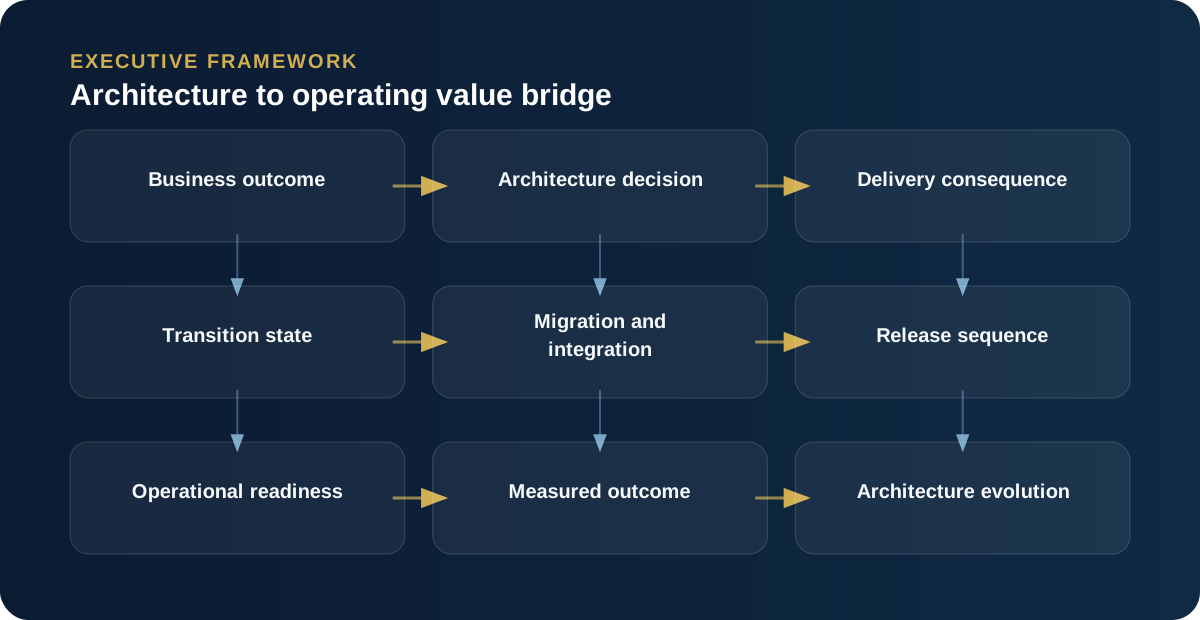
The gap between architecture and delivery is rarely caused by one side being “too technical” and the other “too delivery-focused”. It is usually caused by missing translation between design choices and delivery consequences.
An architecture can be elegant and still be undeliverable in the programme window. A delivery plan can be efficient and still lock the organisation into a poor target state. Leadership has to keep both truths visible at the same time.
Every architecture decision creates delivery work
Choose a new identity pattern and you create integration, migration and testing work. Introduce an API layer and you create contracts, observability, security, environments and ownership decisions. Redesign the data model and you change migration, reporting and downstream interfaces. Move to event-driven integration and you introduce new operational failure modes and support responsibilities.
The architecture review should therefore ask not only “is this pattern appropriate?” but also “what does this choice require the programme to do?”
The delivery plan is an architectural artefact
Sequencing reveals whether the architecture has been thought through. If the programme needs the new data model before application migration, the data work cannot be treated as a late technical stream. If a new API gateway is a prerequisite for several interfaces, environment and security decisions need to land early. If two platforms must coexist for six months, data synchronisation and reconciliation are part of the target transition architecture.
This is why I treat the transition state as seriously as the end state. Executives fund the journey, not just the destination.
Architecture governance should resolve trade-offs, not police diagrams
Weak governance focuses on compliance with standards. Strong governance focuses on decisions: what is the preferred pattern, what exception is being requested, what risk does it create, what is the cost of avoiding that risk, and who owns the consequence?
A transformation leader does not need to become the solution architect of every component. They do need enough technical depth to challenge whether an architecture decision is creating disproportionate delivery risk, hidden operational cost or dependency.
Use architecture decision records with programme consequences
Architecture decision records are most valuable when they include more than technical rationale. I would add four fields: delivery impact, migration impact, operating impact and reversal cost.
That makes the record useful to programme governance. A decision to adopt a particular integration pattern can then be linked to additional environments, skills, vendor work, test scenarios and support capability. The programme can decide with full information rather than discover those consequences during build.
Five signs the architecture–delivery bridge is weak
- The roadmap contains technical workstreams whose dependency on business releases is unclear.
- Architecture decisions are approved without cost or sequencing implications.
- Delivery estimates assume data and integration complexity will be solved later.
- Operations and support teams see the design shortly before go-live.
- Temporary transition solutions become permanent because nobody designed the exit.
What good looks like
Business capability, architecture and release sequencing should tell the same story at different levels of detail. The executive roadmap explains which capabilities arrive when. The architecture explains what must change to enable them. The delivery plan explains the work and dependencies. The operational model explains how the resulting service will be run.
When those artefacts disagree, the programme does not have an architecture problem or a planning problem. It has an alignment problem.
The leadership task is to surface that disagreement early, while the organisation can still choose.
Every architecture decision creates a delivery obligation
An architecture diagram can make a target state look clean because it suppresses time. Delivery has to live through the transition. If an organisation chooses a new identity platform, API layer, data model or eventing pattern, somebody has to migrate consumers, run old and new paths together, handle reconciliation, change monitoring, update support procedures and decide when the old component can safely be removed. The decision is incomplete until those obligations are understood.
That is why I like architecture decision records that include four fields beyond the normal rationale: migration consequence, delivery dependency, operational consequence and reversal cost. A technically elegant option with a two-year transition and high irreversibility may still be right, but the steering group should see that reality when it approves the direction.
The transformation leader does not need to be the chief designer
Technical depth is valuable because it enables better questions. The leadership role is to test whether the architecture can survive contact with programme constraints: sequencing, funding, vendor boundaries, release windows, data migration, security approval, service ownership and skills. It is also to protect architects from being forced into locally convenient decisions that create long-term structural debt.
Make transition architecture a first-class artefact
For large programmes I want three pictures, not one: current state, target state and the major transition states between them. The transition view should show temporary integrations, coexistence, migration waves, duplicated capabilities and decommissioning gates. It often reveals the real risk much earlier than a target-state diagram. It also gives delivery teams a common language for planning releases without treating architecture as a distant end-state aspiration.