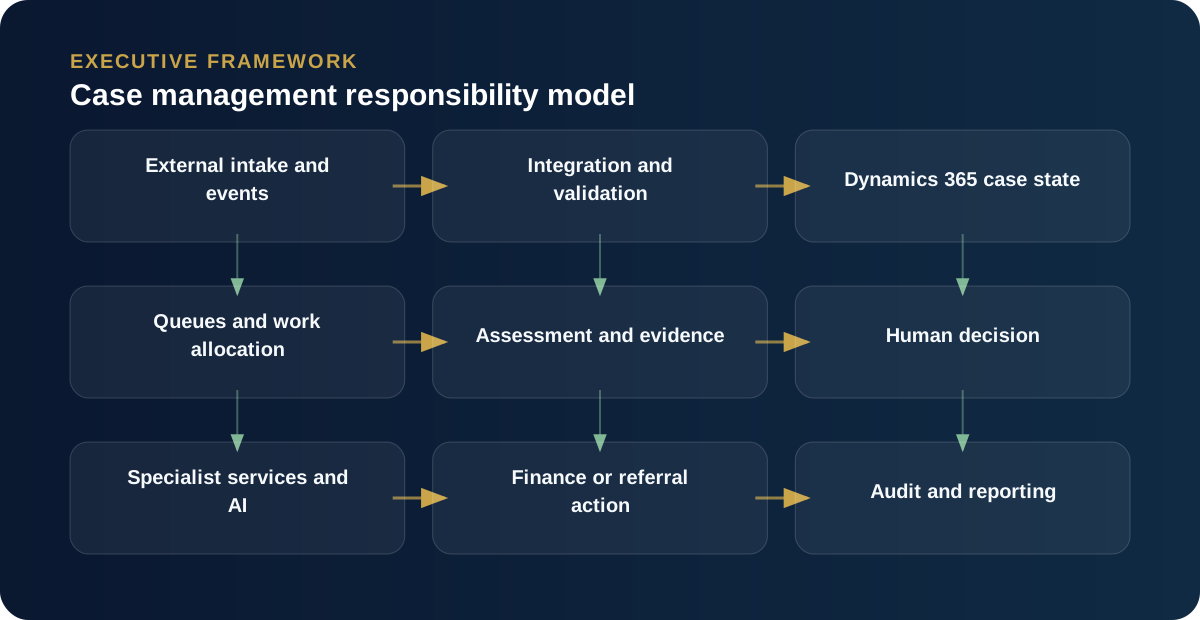
The most important design decision in a case-management transformation is not the form layout. It is the boundary of responsibility between the CRM, the workflow, external systems and the human decision-maker.
That boundary becomes especially important in emergency assistance, hardship payments, regulatory casework and other services where a case may affect money, eligibility or personal outcomes. These environments need speed, but they also need traceability. A platform such as Dynamics 365 can be an effective operational core if it is used for the things a case platform is good at: state, ownership, work distribution, evidence, interaction history, approval and controlled lifecycle management.
Start with the service model, not the table list
A common implementation pattern begins by asking what entities are required. I would begin one level higher. What event creates demand? What programmes or service types are activated by that event? What applications or cases are received? Who can see them? How are they triaged? Which facts are assessed? What external decisions or payments are invoked? What constitutes closure?
In an event-led assistance model, that can naturally become a hierarchy such as Event → Programme → Application → Assessment → Outcome. That is more than a tidy data model. It creates a control structure. Eligibility rules can vary by programme. Reporting can aggregate by event. Queues can separate work types. An applicant can participate in more than one case without duplicating the person record. External integrations have an explicit business context.
CRM should own the work state
The CRM should normally be authoritative for the operational state of the case: received, in review, assigned, awaiting information, assessed, approved, rejected, referred, paid, appealed or closed. It should also own the user-facing work queue, assignment history, notes, activities, approvals and audit trail.
Microsoft's unified routing capability is useful because it treats work distribution as a configurable operating capability rather than a fixed list view. Queues, workstreams, assignment methods and routing diagnostics can be used to separate different classes of work and to manage who receives what. The newer Copilot Service workspace adds a higher-productivity surface for representatives and increasingly supports AI-assisted case preparation and lifecycle tasks with human oversight.
But platform capability should not be mistaken for permission to centralise everything.
Keep specialist intelligence behind clean interfaces
Geospatial eligibility is a good example. The CRM may display whether an address falls inside an impacted area, but the spatial calculation can be performed by a specialist service using authoritative polygon data. Identity verification may be performed by an external provider. Payments may be generated through a finance interface. Emergency alerts may come through a public standard such as CAP. Each capability should expose a clear result and evidence into the case rather than forcing the CRM to become a GIS engine, identity platform, finance ledger and alerting platform simultaneously.
The same principle applies to AI. The case platform should provide controlled context and accept recommendations or approved actions. Model orchestration, evaluation and grounding may belong in an AI service layer with tighter controls than an ordinary workflow.
Design queues around decision work, not organisational charts
Teams frequently reproduce the current organisational structure in the queue model: Team A queue, Team B queue, Provider C queue. That can work, but it often makes the system brittle when responsibility changes. A better question is what kind of work is being performed.
For example: untriaged relief applications, complex assessments, appeals, referral cases, suspected duplicates, finance exceptions and information-required cases are operationally different. They may need different service levels, skills, access rules and automation. Mapping those work classes first creates a more adaptable queue model.
The most valuable AI is usually before the decision
Case environments are rich with AI opportunities because officers spend significant time assembling context. AI can prepare a case summary, highlight missing evidence, detect likely duplicate household applications, classify correspondence, retrieve relevant policy, suggest queue priority and identify anomalies. Those are material productivity gains.
The design should distinguish evidence preparation from decision authority. Microsoft’s 2026 Customer Service direction increasingly supports agentic case capabilities and AI-orchestrated workspaces, but the enterprise still has to decide which actions require explicit approval. Product features do not make that governance decision for you.
A practical responsibility split
- Dynamics 365: case state, ownership, queues, user workflow, interactions, evidence references, approvals, audit and operational reporting.
- Integration layer: reliable exchange with intake channels, identity, finance, document and external service platforms.
- Specialist services: spatial calculation, complex rules, fraud analytics or domain services that should remain independently testable.
- AI layer: grounded retrieval, summarisation, recommendation and bounded automation with evaluation and traceability.
- Human authority: consequential decisions, exception judgement and accountability where policy or legislation requires it.
That separation makes the solution easier to test and change. More importantly, it makes the operating model explainable to an executive, an auditor and the staff who have to use it under pressure.
Design around the case lifecycle, not around screens
Case-management programmes can become trapped in form design: which fields belong on which tab, which view should a team use, and which status values are required. Those details matter, but they should follow the operating model. I would first define the lifecycle of a case and the authority at each transition. What event creates it? What makes it ready for triage? Who can assign it? What evidence makes it assessable? Which decision is being made? What happens when information is missing, the applicant is ineligible, a payment fails or an appeal is lodged?
Once those transitions are explicit, Dynamics 365 becomes easier to shape. Dataverse can hold authoritative case state and relationships. Business rules and automation can enforce deterministic controls. Queues can expose workload. Unified routing can help match work to capacity and skill. Power Automate or APIs can orchestrate integrations. Copilot capabilities can summarise or assist, but they should not become a substitute for a coherent case state model.
The boundary between configuration and code matters
Low-code platforms make it easy to put logic everywhere. That is also how maintainability is lost. I prefer to keep simple validation and user guidance close to the application, workflow orchestration in an explicit automation layer, integration contracts behind APIs, and complex or reusable domain logic in components that can be versioned and tested properly. The objective is not to minimise code at any cost; it is to make ownership and change impact clear.
Operational measures should be designed with the data model
An executive will eventually ask why cases are ageing, where the bottleneck sits, how much work is being re-routed and whether service levels differ by programme. If the data model only records the current status, those questions become difficult. I would capture meaningful lifecycle timestamps, assignment history, exception reasons and outcome evidence from the beginning. Good case management is not just processing work. It creates an operational record from which the service can learn.