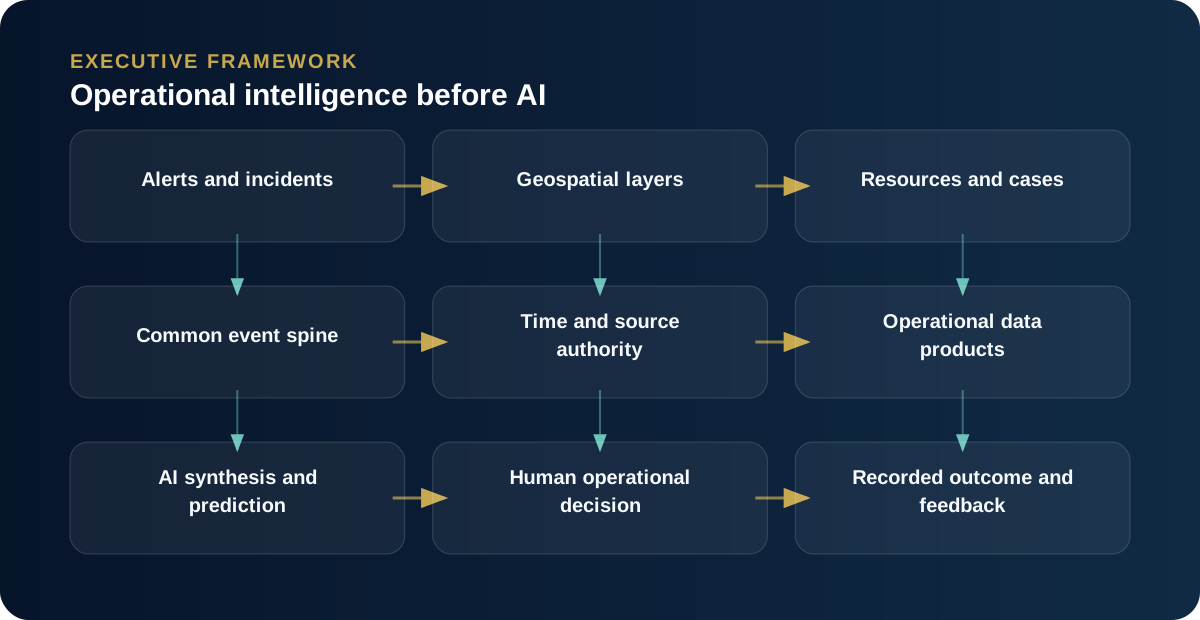
Emergency-services organisations do not suffer from a shortage of data. They suffer from fragmented operational truth. Alerts, incident feeds, GIS layers, call records, resource status, case systems, weather, infrastructure data and partner information may all exist. The challenge is that they often describe different slices of the event using different identifiers, timings and levels of authority.
AI can help interpret that complexity, but it cannot compensate for an operating model in which nobody knows which record is authoritative.
Start with the operational questions
Before designing an “AI platform”, identify the decisions the organisation needs to make under pressure. Where is the event? How is it changing? Which communities or assets are exposed? What resources are available? Which warnings are current? Which applications or requests relate to the event? What has already been assessed? Where are queues building?
Those questions define the data architecture far more usefully than a catalogue of systems.
Build a common event spine
An event spine is the minimum shared structure that allows different systems to refer to the same operational situation. It might contain an event identifier, event type, status, effective time, geographic footprint, source references, related warnings, affected areas and programme or response context.
External alert standards such as the Common Alerting Protocol are valuable because they create machine-readable messages with identifiers, timestamps, status, event information and geographic areas. The operational platform can ingest those signals and associate them with an internal event record without treating every external message as a new event.
Location should be a first-class data type
Emergency data is inherently spatial. Incidents, warnings, roads, properties, shelters, facilities, resources and applicants all have location. Storing location as free text and adding maps later creates avoidable complexity.
A better design treats geometry, address, coordinate reference, precision, source and effective time as governed data. That allows spatial questions to be answered consistently: inside an impact area, nearest available resource, overlapping warnings, assets within a buffer, cases associated with a declared zone.
Operational time matters as much as location
A warning polygon at 10:00 may not be the polygon at 14:00. A resource that was available five minutes ago may now be committed. A road closure may invalidate a previously optimal route. Emergency intelligence therefore needs temporal context: when was this fact true, when was it received, and has it been superseded?
AI recommendations without time-aware data can be dangerously plausible.
Create data products around decisions
Instead of one giant emergency data lake, I would define operational data products around decision domains: event picture, warning picture, resource picture, affected-community picture, case-work picture and infrastructure picture. Each product should have an owner, authoritative sources, freshness expectations and quality measures.
This creates a clean foundation for AI. A model can retrieve from the event picture knowing that the product has already resolved source precedence and identity.
AI belongs above the operational intelligence layer
Once the data foundation is coherent, AI can perform useful synthesis: summarise changes since the last shift, identify conflicting reports, prioritise cases, detect duplicate applications, retrieve policy, explain a spatial relationship, or prepare a resource brief.
The AI should not become the system of record. Its value is to reason over trusted operational data and help people navigate complexity.
Five tests for an AI-ready emergency data environment
- Can different agencies and systems refer to the same event unambiguously?
- Are geographic data and effective time preserved, not just displayed?
- Is source authority defined when two feeds disagree?
- Can an AI output cite the operational evidence it used?
- Can the organisation reconstruct the information state that existed when a consequential decision was made?
Emergency AI is ultimately a decision-support problem. The quality of that support depends on whether the organisation has built an operational truth layer before adding intelligence on top.
Start with an operational event spine
Emergency operations produce many kinds of information: alerts, incidents, locations, warnings, resources, applications, vulnerable people, road impacts, service requests and agency actions. AI is far more useful when those records can be related to a stable event and time context. I call that the event spine. It does not mean forcing every agency into one database. It means agreeing on the identifiers and relationships required to connect operational facts.
For an emergency assistance service, for example, an application should be relatable to the declared event, programme, impacted area version, applicant, property, assessment and outcome. That makes it possible to ask meaningful questions later: how demand moved as the event evolved, where applications fell outside affected zones, which cohorts experienced delays and where duplicate or anomalous patterns emerged.
Operational intelligence is a product, not a dashboard
A dashboard is only the presentation layer. The product includes source contracts, refresh expectations, data quality rules, ownership, semantic definitions and the operational decisions it is intended to support. A map that updates every fifteen minutes may be excellent for strategic awareness and unacceptable for dispatch. A daily application trend may be sufficient for staffing and useless for immediate triage. Decision latency should determine the data design.
Then AI has something reliable to work with
Once events, entities, time and spatial context are governed, AI can help summarise situation changes, prioritise work, detect unusual demand, retrieve policy, identify possible duplicates and support scenario analysis. Without that foundation, the model spends its effort reconciling ambiguity that the data architecture should have resolved. The executive lesson is straightforward: the fastest path to useful emergency AI is often investment in operational data discipline first.