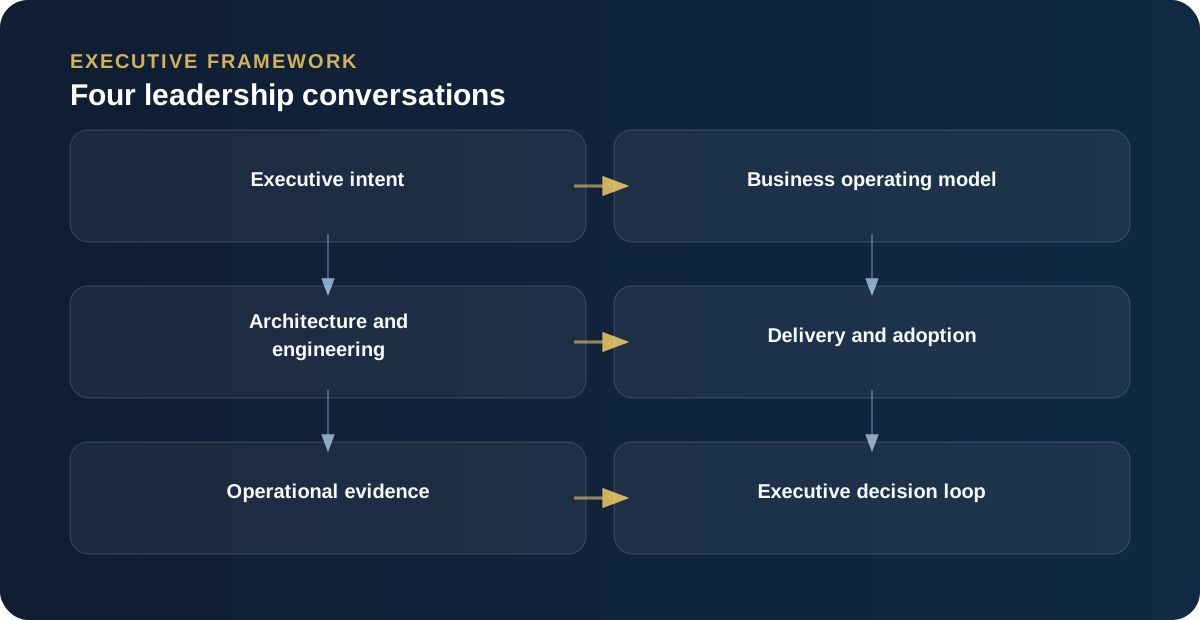
Transformation fails in the gaps between conversations. The board approves an outcome. The business describes a process. Architects define a solution. Delivery teams build a backlog. Each artefact may be locally correct while the programme as a whole drifts.
The leadership skill is not to replace any of those disciplines. It is to make sure they remain connected.
Conversation one: executive intent
Executives need to understand what is changing, why the investment matters, what outcome is expected, which risks are being accepted and what decisions are required. They do not need a compressed architecture presentation full of acronyms.
The leader's job is to convert technical complexity into choices without hiding the material trade-offs. “We need an API gateway” is not an executive decision. “We can continue building point-to-point integrations more quickly now, or invest in a reusable integration control that reduces future change cost but adds three months to the foundation work” is.
Conversation two: business operating reality
Business stakeholders describe work through customers, policies, exceptions, service levels, pain points and informal practices. The leader has to understand enough of that reality to know when a technology discussion is solving the wrong process.
Transformation is not a system replacement if the process, ownership, controls and information flows remain untouched. Nor is every process change a technology requirement. Keeping those distinctions clear prevents the backlog from becoming a dumping ground for unresolved operating-model questions.
Conversation three: architecture and engineering
Architecture translates needs into structures: platforms, boundaries, data, identity, integrations, security, non-functional requirements and transition states. This conversation requires precision. A vague promise that the platform is “scalable” or “AI-ready” is not enough.
A transformation leader does not need to design every component. They do need to challenge whether the architecture supports the promised operating outcome and whether hidden technical debt is being deferred into delivery.
Conversation four: delivery and adoption
Delivery asks what can be built, tested, migrated and adopted in sequence. It exposes capacity, dependency, environment and vendor constraints. This is where strategy meets calendar time.
The mistake is treating delivery as execution after the important decisions have been made. Delivery evidence should change decisions. If a data-model assumption proves wrong, the forecast and architecture may need to change. If users cannot absorb a release, sequencing may need to change even if engineering is ready.
The translation artefacts matter
Strong programmes use a small number of artefacts to connect the four conversations: an outcome roadmap, capability map, operating-process model, architecture decisions, dependency-based release plan and evidence-based forecast. Each should be understandable to its primary audience while remaining traceable to the others.
When an executive asks why a release moved, the answer should be traceable to a real dependency or decision. When an engineer asks why a requirement exists, it should be traceable to a business outcome or control. Traceability is not documentation bureaucracy when it connects decisions.
Questions I use to test alignment
- Can the executive outcome be expressed in observable operational terms?
- Can the business process show where that outcome is created?
- Can the architecture explain what capabilities and controls enable it?
- Can the delivery plan show when those enabling pieces become usable?
- Can operational measures tell us whether the promised outcome actually arrived?
If one answer is missing, the programme has a translation gap. Closing those gaps is one of the highest-leverage things a technology leader can do.
The failure usually happens in the translation
Most organisations have people capable of each conversation. The problem is the hand-off between them. An executive says the programme must “simplify the customer journey.” The business translates that into a new process. Architecture interprets the process as platform and integration changes. Delivery turns those into increments, dependencies and release plans. Months later the organisation discovers that each group carried a slightly different meaning of “simplify”.
The leadership value is not in personally producing every artefact. It is in keeping the line of sight intact. I use a small set of translation artefacts: outcome and benefit measures for the executive conversation; process and decision models for the business conversation; architecture decisions and non-functional requirements for the technical conversation; and an integrated delivery view that connects dependencies, milestones and acceptance evidence. When one changes, the effect on the others should be visible.
Different rooms require different levels of resolution
A board does not need a sequence diagram, and an integration engineer cannot work from a benefits statement. Oversimplifying technical risk for executives is dangerous; drowning them in implementation detail is equally unhelpful. The skill is to preserve the consequence while changing the resolution. “The API is not finished” is delivery detail. “The external intake interface is on the critical path and the authentication decision is still unresolved” is an executive-relevant translation of the same problem.
One question keeps the four conversations connected
At any point in a transformation I should be able to ask: what decision or outcome does this piece of work enable? If the delivery team cannot answer it, the backlog may have become detached from value. If architecture cannot answer it, the programme may be designing for elegance rather than need. If the business cannot answer it, requirements may be documenting the current process rather than changing it. That question is simple, but it is one of the most effective ways I know to keep a complex programme coherent.