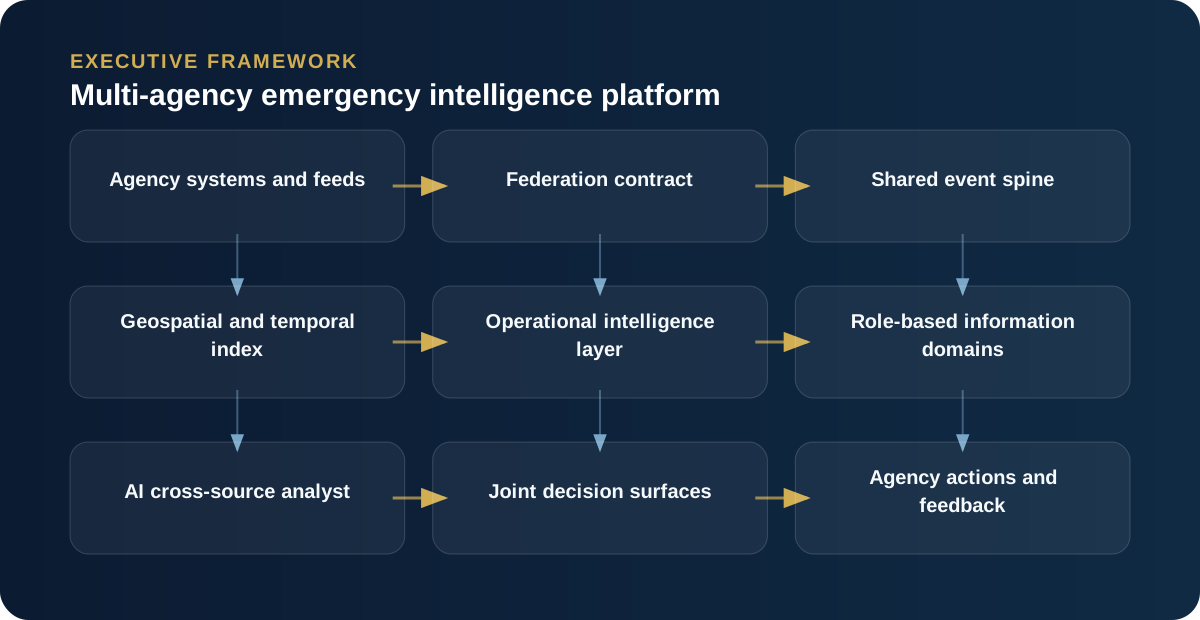
A multi-agency emergency platform should create a common operating picture without pretending that one organisation can replace every specialist system.
Police, fire, health, local government, emergency management, utilities and community-service organisations may all participate in the same event. They have different responsibilities, data sensitivities, systems and definitions of what matters. The architecture needs shared truth where collaboration is required and local authority where domain responsibility remains distinct.
The scenario
Consider a major flood affecting several municipalities. Public warning feeds publish changing polygons. Road conditions alter access. Local councils manage facilities and community information. Emergency agencies manage incidents and resources. A hardship-service platform receives applications from affected households. Utility outages and asset data change the risk picture.
The executive objective is not to create one enormous database. It is to improve situational awareness and cross-agency decision speed.
Define a federation contract
The platform needs common concepts that agencies agree to exchange: event identifier, time, location, source, status, organisation, resource reference, affected asset or community reference, and data sensitivity. These become the federation contract.
Each agency can retain its operational system while publishing selected data products through APIs, event streams or governed extracts. The shared platform maintains links and derived intelligence rather than claiming ownership of every source record.
Use an event-centric architecture
The event becomes the shared context through which information is related. Warnings, incidents, resources, closures, assets, assistance programmes and public reports can all be associated to the event and time window.
This is especially important when multiple external identifiers exist. The platform can maintain a cross-reference rather than forcing source systems to change their identifiers during an emergency.
Geospatial indexing is the integration layer people forget
Agencies may not share business keys, but they often share geography. A road closure, warning polygon, facility, property, resource and application can be related spatially even when source systems have no direct relationship.
A spatial index therefore becomes a powerful cross-agency integration mechanism. It allows questions such as: Which critical facilities are inside the updated warning area? Which open assistance cases relate to properties in the zone? Which resources are closest and reachable?
Security should follow information domains
A common operating picture does not mean common access to everything. Public warning information, operational resource data, personally identifiable information and law-enforcement data have different access models.
I would design information domains and claims-based access so that users and agents receive only the data required for their role and purpose. Derived AI outputs should inherit the sensitivity of the source material.
AI is most useful as a cross-source analyst
Once the federation exists, AI can summarise event changes, identify information conflicts, retrieve relevant operating procedures, correlate affected assets, prepare briefings and highlight areas where evidence is stale or missing.
An AI-generated briefing should cite the underlying sources and timestamps. In a multi-agency environment, provenance is essential because different agencies may legitimately hold different perspectives.
A phased implementation
- Phase 1: shared event and alert picture using public and agency feeds.
- Phase 2: geospatial correlation of assets, infrastructure and service areas.
- Phase 3: selected operational resource and case-work integration.
- Phase 4: AI-generated briefings, anomaly detection and decision support.
- Phase 5: more advanced predictive or agentic workflows where decision rights are agreed.
The governance model is part of the platform
The federation needs data owners, source precedence, incident-time escalation, schema change control and agreed service levels. Without that, the technology simply moves ambiguity into a shared screen.
The design goal is a platform that improves joint decisions while respecting the operational sovereignty of participating agencies. That is harder than buying a dashboard. It is also far more valuable.
Federation is usually more realistic than centralisation
Multi-agency programmes often begin with an attractive idea: create one platform containing everything. In practice, agencies have different statutory responsibilities, operational systems, security classifications, data retention obligations and investment cycles. Trying to replace all of that at once can turn an information-sharing problem into an enterprise replacement programme.
I would instead define the smallest shared operating layer: common event identity, agency roles, shared geospatial references, agreed information products, controlled APIs and an auditable way to publish or subscribe to updates. Each agency can retain authoritative systems while the platform connects the facts needed for cross-agency decisions.
Authority needs to travel with the data
An intelligence platform should distinguish what is observed, what is inferred and who is authorised to declare it. A road closure reported by the road authority, a flood extent derived from a model and a social-media report are all useful, but they do not have equal authority. Metadata about source, time, confidence and stewardship is therefore part of the operational product.
Phase the capability around decisions
A sensible first release might focus on a small number of decisions: shared event awareness, impacted-area visibility and cross-agency resource or service status. Later releases can add predictive products, automated correlation and agentic assistance. This keeps the programme grounded in operational value and provides real data with which to evaluate AI.
The architecture should also assume partial failure. During an emergency, connectivity, source systems or feeds may degrade. Local caching, clear staleness indicators, reconciliation and manual fallback are not secondary requirements. They are part of the resilience model of the service.